
Introducing The Creative Technologist
A new newsletter from Baukunst


What is a Creative Technologist?
By Tyler Mincey, Co-founder & General Partner at Baukunst
For as long as I’ve been working in tech, I’ve felt the most at home in small rooms where the line between “designer” and “engineer” is blurry. Some of my most cherished memories of Apple are of working with incredibly talented industrial designers who could rattle off LED wavelengths, aluminum alloys, and machining techniques; working with engineering colleagues who thought deeply about affordances and moved technical mountains to fight for design intent.
In some workplaces, there are technical experts without vision, and visionary thinkers whose aspirations are unmoored from reality. I’ve always considered the people who put both of those skills together to be wizards of a kind.
These wizards belong to a different archetype than the purely technical engineer or the craftsperson, and also differ from the idea guy, futurist, or prima donna designer. Instead they marry craft and vision, “what’s possible” with “what we want.” These are the people I call creative technologists.
—
Creative technologists draw on deeply interdisciplinary backgrounds. We bristle at “jack of all trades, master of none.” Our breadth of expertise is a creative superpower that sows the seeds of insight, creates the sparkgaps between fields.
Our work begins with empathy for need and a vision for the future. We bend technology in service of those.
We have a rebellious disregard for authority, but a deep respect for those who have blazed new trails.
We work in demos more than specs.
We know how to shelter the spark of an idea and fan the flames.
We defend play against extreme efficiency.
We know aesthetics and elegance matter, but design is how it works.
We defer to intuition, and we relentlessly ask why, expecting others to do the same.
We embrace business considerations as part of the design space. We seek business model innovation alongside product innovation as a means of achieving sustainable impact.
We obsess over details but have an insatiable desire to ship.
Being part of the magic composition of humans that shipped the first iPhone and many generations of iPods, I know small teams of people working in this way can be a white hot nucleus of change in the world. I’ve seen it.
—
Design, as well as the notion of “creativity” at large, have always been undervalued in technical contexts. The excesses of big tech, such as “creative technologist” job titles for roles that mainly make tech demos, have only worsened this misvaluation. But creative technologists’ historical track record of building some of the most respected companies in the world tells an entirely different story, one in which we play the leading role.
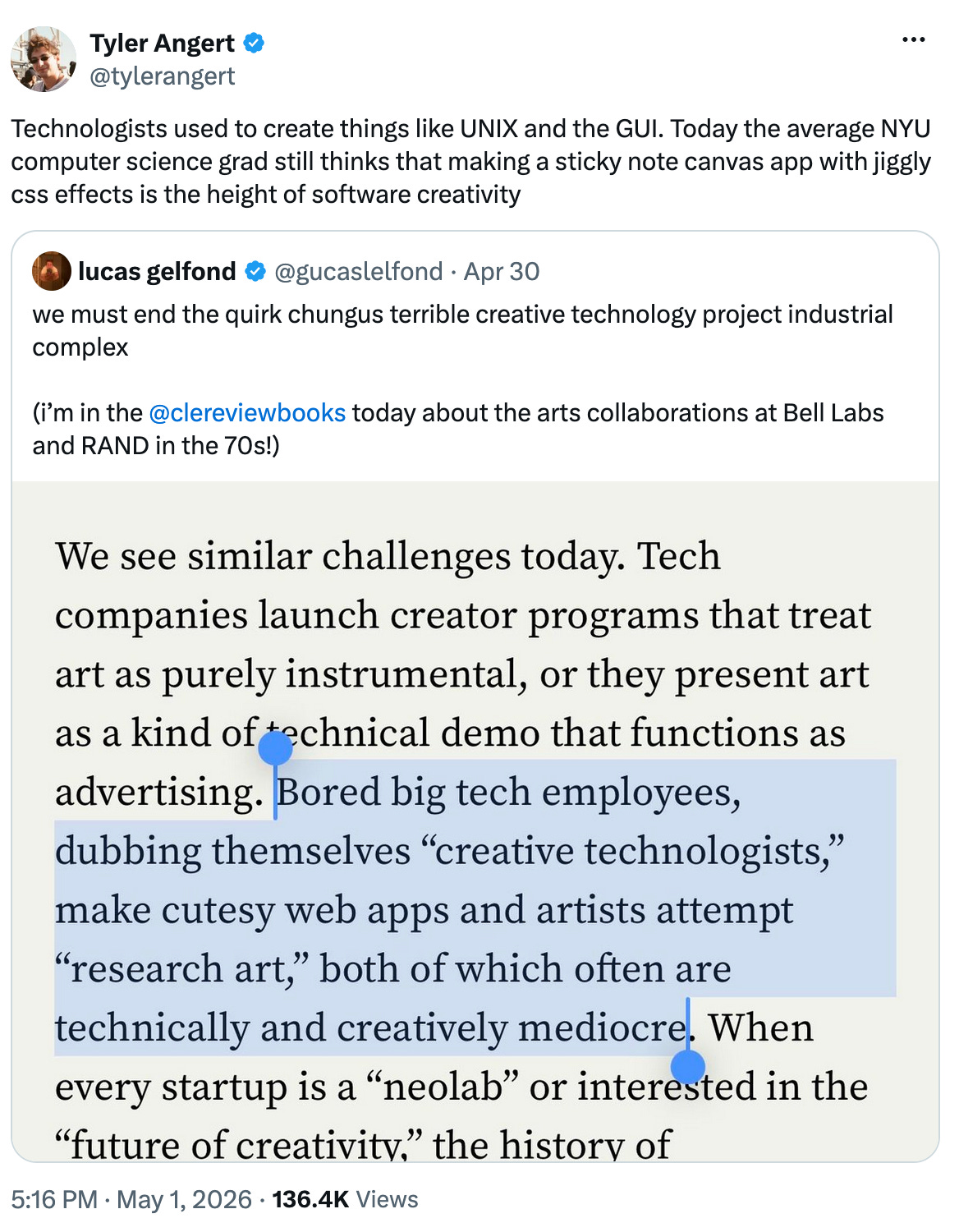
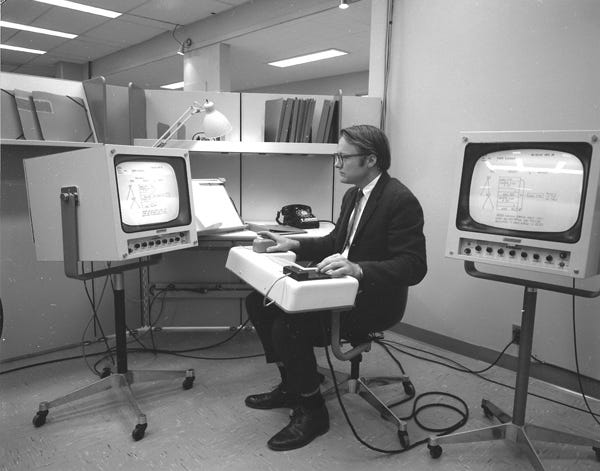
We claim inspiration from groundbreaking research and educational institutions like Bauhaus, Black Mountain College, Bell Labs, Xerox PARC, and MIT Media Lab. This chain of organizations, led by people like Josef and Annie Albert and Doug Englebart, exemplify the creative technologist’s instinct to begin with a human-centric aspiration worthy of actualization.
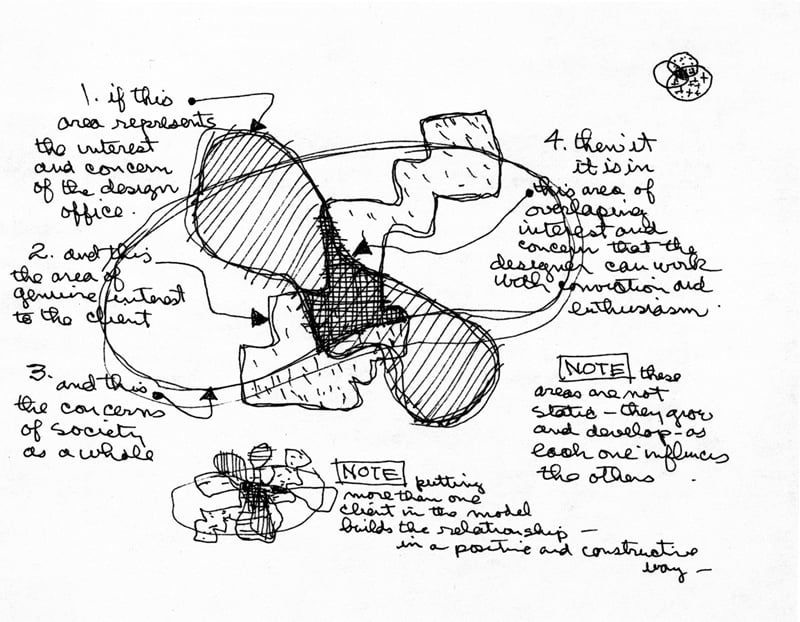
We claim heritage from interdisciplinary creative studios like the Eames Office, IDEO, frog, Pentagram, and Miyake Design Studio. Greats like Ray and Charles Eames, masters of high design in commercial settings, teach us that the most generative opportunities are where business, design, and societal interests overlap.
We claim the global impact of companies like Atari, Apple, Pixar, Sony, Olivetti, Dyson, Nintendo, SGI, Adobe, Autodesk, and Airbnb. All founded by creative technologists or embodying the creative technologist DNA collectively in their organizations. Steve Wozniak is perhaps the creative technologist in purest form, an engineer whose designs were admired for their elegance and economy. His Apple I and Apple II designs balanced computer architecture, manufacturability, cost, software, user experience, and most importantly delight, laying the foundation of the most successful personal computer company of all time.
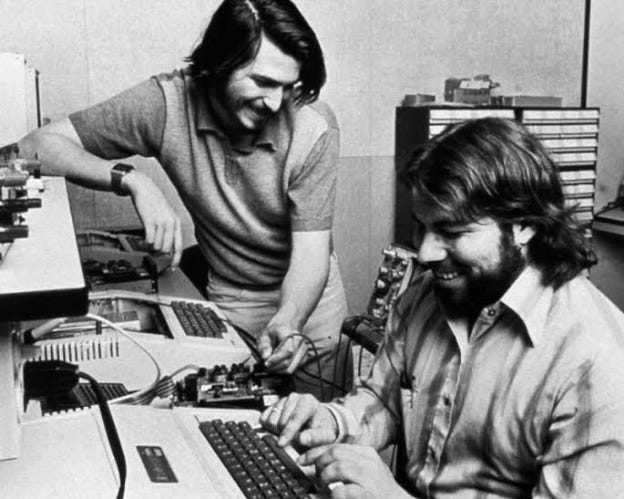
I invoke this pantheon not to engage in hero worship, but to underscore the heritage of impact that creative technologists pass from generation to generation.
—
I consider the influence of creative technologists to be the secret story of tech’s most positive impacts, one that could be the subject of a book or movie. Recently, though, it feels to me that people are coming around to appreciating the role. In the age of AI, when the cost of building is plummeting, we hear about the importance of “taste” and see design engineering roles on hiring boards.
But it also feels that some of these “taste” champions have downright anti-technical attitudes. Gleeful that they don’t have to think about implementation—that they can just prompt what they want and “one-shot” it—they seem to be saying “finally we idea guys can be technologists, without engaging with technology!” As if all craft could be encoded in an embedding, all outcomes compressed in a prompt.
The way we’re now awash in slop demonstrates this anti-technical tendency. When it’s so easy to prompt something into reality, you’re not forced to design something that’s worthy of being built in the first place. You’re sidestepping the crucible of evaluating tradeoffs, a crucible that ultimately makes the product better. As a result, bad designs are what AI is scaling.
But there is a more urgent risk: that our lives will simply be dictated by technology’s most obvious dynamics. It feels like we’re racing toward a sci-fi future that I don’t know if I want to be a part of: eliminating beautiful inefficiencies for short term economic gains, removing frictions and participation we find meaningful, and eating resources without asking whether it’s all worth it.
Technological accelerationists are means-maxers. The thing they’re accelerating is capabilities and tech tree advancement, without considering what ends are worth accelerating towards. And if this state of affairs is left to fester, we will end up living inside powerful systems that are undesigned. We will end up down a path of technological change without a vision of where we want to go.
If people neither understand the technology, nor how to create a designed vision, then both sides of the “creative technologist” venn diagram collapse.
As creative technologists, our goal is to find what is human and beautiful: to propose, prototype, and scale forms of living that support those essential qualities.
We don’t just want capable systems. We want emotionally resonant, aspirational visions of the future that include us—visions that not only move us, but are backed by what’s possible, so that these visions deserve our belief.
Now more than ever, we need builders who deeply understand and appreciate positive human experiences of love, joy, excitement, warmth. Who know the pain of loss and suffering, loneliness and dejection. Who understand inherently that valuable human experiences are part of what makes them so good as designers, leaders, and founders.
—
At Baukunst, we are a collective of creative technologists building companies at the frontiers of technology and design. Our founder Kishan Chalumuri is an industrial engineer with a vision for revitalized manufacturing built on powerful + elegant software. Lauryn Menard is a world-class industrial designer working on personal care products that point towards a regenerative future. In all our work as investors, community-builders, storytellers, we strive to advance this “art of building.” We back founders and support thinkers in the lineage of Walt and Woz, Bowerman and Buckminster, Engelbart and Eno, Koolhaas and Kay.
We’re in our fourth year of thoughtfully building this collective, and with each year our imperative to rally kindred spirits grows.
We started Baukunst because we believed that creative technologists needed a supportive group and a dedicated fund to back the work that they do. And we think it’s high time to strengthen the conversation around this work. For all those in pursuit of the art of building.
— Tyler Mincey, Co-founder & General Partner at Baukunst
San Francisco Creative Technology Happenings
This section of our newsletter covers news and upcoming events.
Audium | Audium is a legendary sound space in San Francisco. Every Thursday, Friday, and Saturday in June, artist Barba Nerness is in residency at Audium, creating interactive, participatory sound sculpture with audience members’ heartbeats. Get tickets to BIOMETRICKS.
TIAT | TIAT has an open call out to participate in their next exhibition, Epistemologies of Slop. “We are looking for works that engage slop not only as an aesthetic, but as a social, technical, economic, and psychological condition. We welcome critiques of slop. We are also looking for works that embody it, aestheticize it, weaponize it, surrender to it, or reveal the strange new forms of culture emerging from within it.”
Gray Area | Gray Area has so many amazing performances and workshops coming up, but one you shouldn’t miss is a course on making mini-games for the PICO-8 virtual console.
Baukunst Updates
YouPop Raises $1M Pre-Seed to Build AI Infrastructure for Creators

Solo founder Sarina Virk Torrendell is one of tech’s secret weapons for launching and scaling new consumer experiences. From launching Postmates markets as employee twelve to scaling consumer adoption at Apple Pay, she’s built enormous businesses across categories.
Over her career, Sarina has seen and leveraged every trend in influencer marketing. Now Sarina’s building a company to help usher knowledge creators into the AI era. YouPop brings together all an influencer’s expertise—across courses, podcasts, newsletters, and posts—and makes it searchable and shoppable for audiences.
YouPop just launched into private alpha with top knowledge creators. Join the waitlist at youpop.ai.
DannijoPro Featured in New York Times

Baukunst founders Danielle and Jodie Snyder headline a new New York Times feature about their women’s sports apparel business, DannijoPro. Second-time entrepreneurs Danielle and Jodie have intrepidly entered the sports merchandise market with their creative take on luxury bombers and cropped jackets, knitwear, and hand-stitched items. In a world where most women’s sports merch falls victim to the “shrink it and pink it,” trope, their visually striking designs constantly provoke the question: “where did you get that?!” DannijoPro is the go to brand for NBA WAGs (wives and girlfriends) and fueled the fashion side of Knicks fever in their championship run. It’s the hottest merch we’ve ever seen, and we’re so thrilled to be investors where fashion, fandom and culture intersect.
Bindery Book Hits USA Today Bestseller List
Bindery’s latest book, Our Sister’s Keeper, just debuted on the USA Today Bestselling Booklist. That makes it Bindery’s fourth book to hit a major bestseller list!
Recess Expands to Houston and Dallas
Our final shoutout is to Recess, who this month expands from their first market in Austin to Houston and Dallas, two of Texas’ largest metro areas. Founders Amy Kiska and Molly Morse are marketplace expansion experts, previously having led new markets for companies like INFARM, Christian Louboutin, Block Renovation, and Bellhop. Congrats on this major milestone.
Events
First Fridays at the Baukunst Studio
On the first Friday of every month, we host an open studio party featuring art, music, and beverages from local vendors. Last Friday we had the pleasure of hosting engineer and musical instrument designer Chris Guichet.


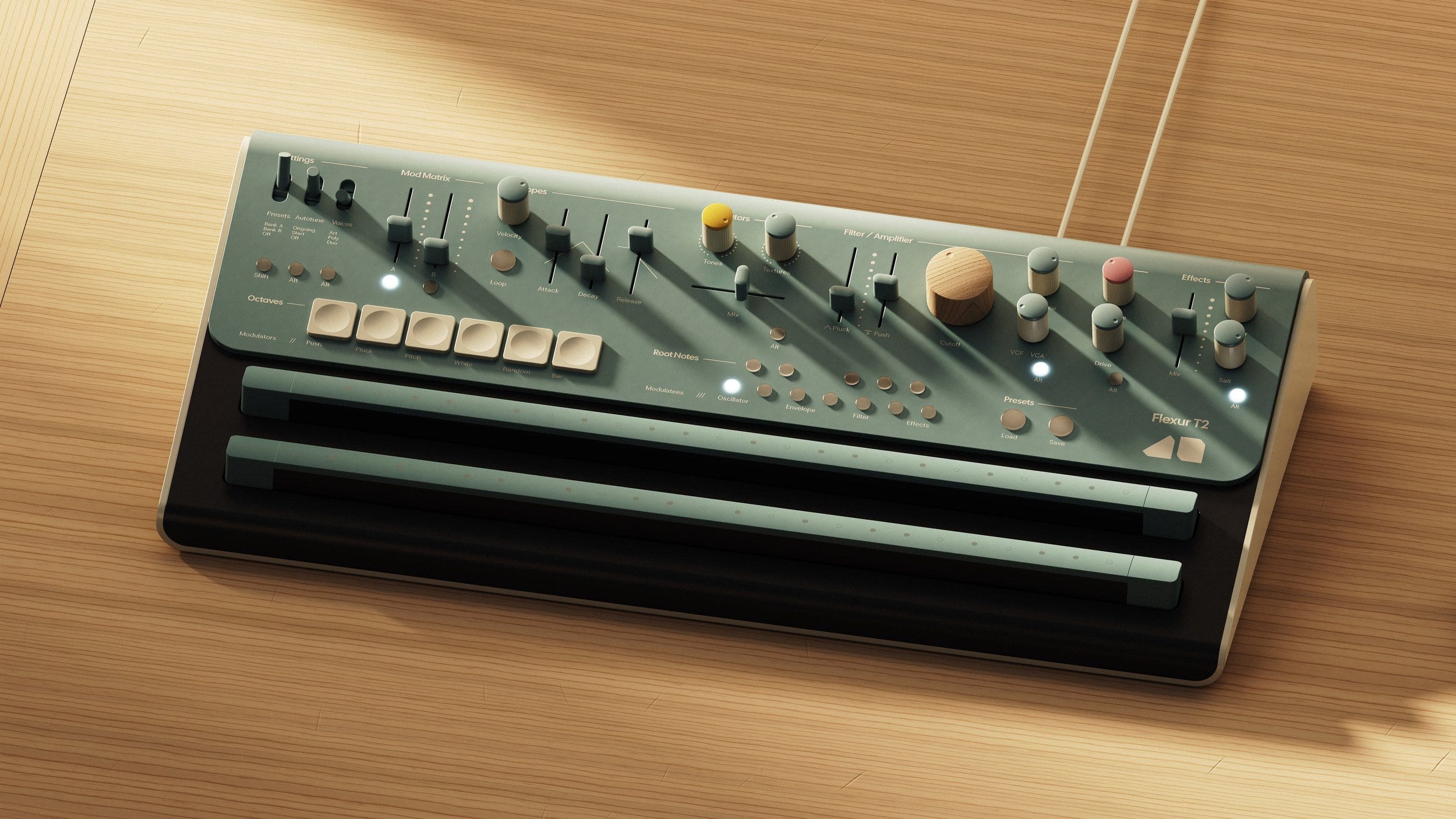
Chris brought a bunch of instruments he’s created, including his latest device, Flexur, an expressive synth with two touch-sensitive bars that can be played like a cello or a pedal steel guitar. He played a bunch of songs for us, including a beautiful rendition of Niel Young’s Harvest Moon, and Black Hole Sun by Muse.
Chris just launched preorders for Flexur. If you’re a synth nerd and you’re in San Francisco, hit Chris up for a demo.
And to get notifications about our next First Fridays event, follow Baukunst on Partiful.
Collective News
Noctrix Health was acquired by sleep health leader Resmed in a $340M deal last week, a satisfying conclusion to a 10 year journey. Baukunst GP Axel Bichara was their pre-seed lead investor.
Baukunst GP Kate McAndrew was honored in the Create & Cultivate 100 list, and gave a great interview about the role of creativity in business and her relationship to money.
Collective member Eric Silberstein has launched an awesome game called TongueTied, a sort of multi-lingual Scrabble where you can win points for bridging between languages.
Collective member Kim Chappell was named one of the top 25 most creative CMOs by Business Insider.
Hardware filesharing network USB Club, co-founded by collective members Norm O’Hagan and Yatu Espinosa, has been acquired by NYC-based creative holding company Garden3d. Congratulations!
Hey Tyler; really love this article; esp. how you describe creative technologist. Was wondering if you have any resources you’d suggest I should read upon/tinker with to get a more in-depth intro? I’m a mbb consultant whose tinkering a lot with ai (in my work and free time) and I’d like to explore this idea of being/becoming ‘creative technologist’
What a beautiful description of a Creative Technologist. Looking forward!